Azerbaijan food
34 notes · generated by structure_markdown.py
Contents
- Armenian Herbal Teas
- Azerbaijani Lamb with Chestnuts
- Baklava Baked Apples
- Beef Shashlik with Tahini and Pistachio Sauce
- Bukharan Family-style Chicken and Rice
- Buttered Rice under a Shah’s Crown
- Chapli Kebabs
- Chicken and Almond Pilaf Pie
- Chicken, Potato and Prune Hotpot
- Dushanbe Pilaf
- Fish and Saffron Pilaf
- Georgian Chicken with Walnut Sauce
- Green-herbed Plov with Chickpeas
- Kazan Kebab
- Kyrgyz Swirled Onion Flatbread
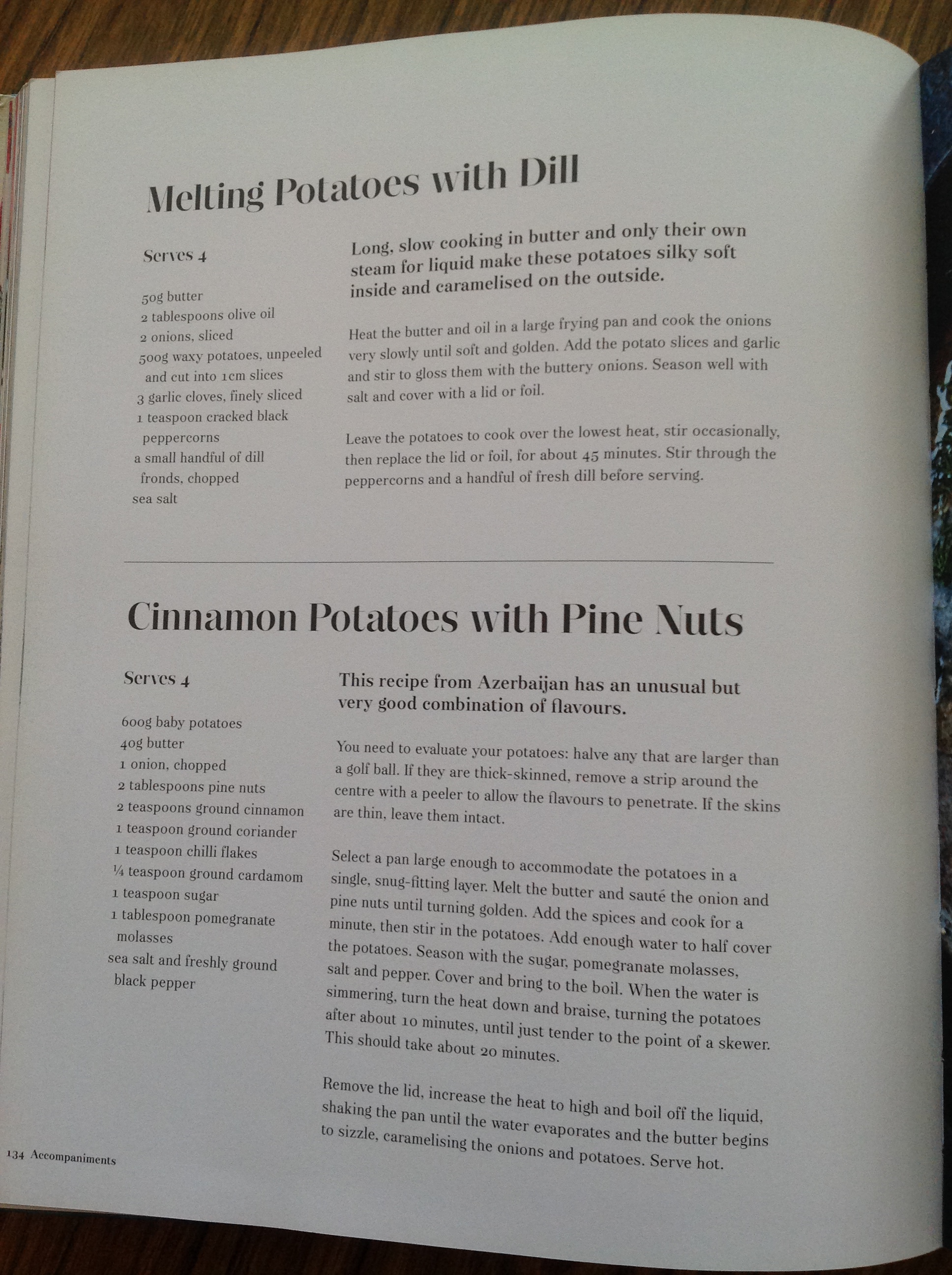
- Melting Potatoes with Dill
- Note
- Note
- Note
- Pistachio Halva
- Pomegranate Soup
- Roasted Cauliflower with Pistachio and Tarragon
- Ruins of a Russian Count’s Castle
- Salmon Kulebyaka
- Samarkand Plov
- Samarkand Plov (page 2)
- Samsa
- Sesame, Almond and Ginger Brittle
- Slow-roast Mutton with Sultan’s Delight
- Spicy Meatballs and Shah’s Crown (more photos)
- Spicy Meatballs with Adjika and Yogurt
- Spinach Khachapuri
- Spinach Khachapuri (second photo)
- Winter Kuksu
Armenian Herbal Teas
Created 2019-04-18 · Updated 2019-04-18
From Samarkand by Caroline Eden & Eleanor Ford (Kyle Books, 2016)
When the winter snows melt, the Armenian Highlands become carpeted with an abundance of wild flowers and herbs. Medieval manuscripts record herbal tea blends that have been made in these regions since ancient times.
Spiced Rose Petal Tea
- For a two-person teapot, add 1 tablespoon organic dried rose petals, ½ cinnamon stick, 2 whole cloves and 3 bruised cardamom pods. Brew with freshly boiled water for 10 minutes.
Springtime Leaves Tea
- To make this blend you need an equal quantity of dried hibiscus flowers, dried oregano, dried blackcurrant leaves and dried nettles. Gather fragrant blackcurrant leaves from hedgerows and be sure to pick nettles before they flower, using gloves of course. Spread out the leaves on a rack and leave in a warm place for a day or two to dry out. Blend to a coarse powder in a food processor. Add 1 teaspoon of the springtime leaves blend per person when brewing a pot of tea and store the rest in an airtight jar.
Armenian Mountain Blend
- For each person, brew 1 teaspoon of lime blossom and ½ teaspoon dried thyme with freshly boiled water for 10 minutes.
Photo
Azerbaijani Lamb with Chestnuts
Created 2019-04-18 · Updated 2019-04-18
From Samarkand by Caroline Eden & Eleanor Ford (Kyle Books, 2016)
This stew of melting lamb in an intriguing, sweet tangy sauce makes an excellent partner for the Buttered Rice under a Shah’s Crown.
Serves 4
Ingredients
- 3 tablespoons olive oil
- 600g braising lamb, cut into chunks
- 2 onions, chopped
- 1 teaspoon fennel seeds
- 1 teaspoon ground cinnamon
- 1 teaspoon Turkish red or Aleppo pepper
- ½ teaspoon ground turmeric
- 3 tablespoons tomato purée
- 300ml pomegranate juice
- 200ml hot lamb or chicken stock
- 2 tablespoons pomegranate molasses
- 100g cooked and peeled chestnuts
- sea salt and freshly ground black pepper
To serve
- fresh mint leaves
- seeds of 1 pomegranate
Method
- Heat the oil in a large, heavy pan and brown the lamb in batches. Set the meat aside and add the onions to the pan to soften and caramelise over a low heat, adding a little more oil if needed. Stir in the spices and tomato purée, then return the lamb to the pan and season with salt and pepper.
- Pour over the pomegranate juice, stock and pomegranate molasses. Bring to the boil, then turn down the heat, cover the pan and simmer for 1½ hours, or until the meat is really tender.
- Add the chestnuts and cook for a further 10 minutes. Garnish with mint and pomegranate seeds and serve.
Photo
Baklava Baked Apples
Created 2019-04-18 · Updated 2019-04-18
From Samarkand by Caroline Eden & Eleanor Ford (Kyle Books, 2016)
Stuffed and baked apples are common in Central Asia, both sweet and savoury. Here, I have filled them with the flavours from another favourite sweet that evolved in the region – baklava. Sticky, scented nuts make the filling, while a shell of crisp pastry encases the fruit.
Serves 4
Ingredients
- 55g walnuts
- ½ teaspoon ground cinnamon
- 1 tablespoon lemon juice
- 50g honey
- 40g brown sugar
- 4 sheets of filo pastry
- 50g butter, melted, plus extra for greasing
- 2 tablespoons caster sugar
- 4 cooking apples, peeled and cored
Method
- Preheat the oven to 190°C/gas mark 5 and butter an ovenproof dish.
- Put the walnuts in a food processor and pulse blend to a coarse rubble. Stir in the cinnamon, lemon juice, honey and brown sugar.
- Work with one sheet of filo at a time, keeping the rest under a clean, damp tea towel. Brush a sheet of pastry with melted butter and sprinkle with a teaspoon of the caster sugar. Fold in half to make a square. Sit an apple in the middle of the pastry and spoon one quarter of the filling into the core. Bring the four corners of pastry up to wrap the apple well, brushing with melted butter as you go. Brush the surface with melted butter and another sprinkle of sugar. Put seam-side up into the baking dish and repeat with the remaining apples.
- Bake for 25–30 minutes, until the pastry shell is golden and the apple inside is tender. Serve warm.
Photo
Beef Shashlik with Tahini and Pistachio Sauce
Created 2019-04-18 · Updated 2019-04-18
From Samarkand by Caroline Eden & Eleanor Ford (Kyle Books, 2016)
In the province of Gazientep, in Turkey’s southeastern Anatolia region, pistachios (sam fıstıgı) are so celebrated that an arts festival is held in their name. The nuts define the region’s food, from the glorious green baklava to these shashlik, meat kebabs studded with pistachios. They can be made with beef or lamb.
Serves 4
Ingredients
For the sauce
- 25g country bread, crusts removed
- 100g shelled pistachios
- 1 small garlic clove, crushed
- 1 tablespoon tahini
- juice of 1 lemon
- 1 tablespoon olive oil
- sea salt and freshly ground black pepper
For the kebabs
- 600g minced beef
- 1 red onion, grated
- 1 garlic clove, crushed
- 100g shelled pistachios, roughly chopped
- 2 teaspoons thyme leaves
- 2 teaspoons ground cumin
- ½ teaspoon cayenne pepper
- ½ teaspoon ground allspice
- 1 teaspoon sea salt
- 1 tablespoon olive oil
- flatbread, to serve
Method
- For the sauce, soak the bread in a bowl of cold water for a few minutes, then squeeze out as much of the water as possible. Put into a food processor with the pistachios and process to a paste. Add the remaining sauce ingredients and blend again. Add enough water to thin the sauce to a smooth, dropping consistency. Season with salt and pepper and refrigerate until needed, but bring to room temperature before serving.
- For the kebabs, put all the ingredients, except the olive oil, into a large bowl. Use your hands to mix everything until smooth. Divide the mixture into eight pieces and shape each into a long thin sausage around a metal skewer.
- Preheat a griddle pan over a high heat. Brush the shashlik with olive oil and cook for 5–10 minutes, turning occasionally, until well browned and cooked through to your liking. Serve with the pistachio sauce and some warm flatbread.
Photo
Bukharan Family-style Chicken and Rice
Created 2019-04-18 · Updated 2019-04-18
From Samarkand by Caroline Eden & Eleanor Ford (Kyle Books, 2016)
Rice dishes in Central Asia tend to be grand affairs made slowly for weekends, holidays and weddings, but they don’t have to be. This simple one-pot family dish is one for weeknights and its gently spiced flavour makes it ideal for children.
This lovely fluffy pile of chicken and rice uses only simple flavours, so use the best ingredients you can. Ideally, that means homemade chicken stock, good-quality chicken, organic carrots and decent basmati rice.
Serves 4
Ingredients
- 2 tablespoons sunflower oil
- 2 onions, chopped
- 3 carrots, coarsely grated
- 2 teaspoons sugar
- 2 skinless chicken breasts, cut into bite-sized pieces
- ½ teaspoon paprika
- 250g basmati rice, rinsed
- 8 garlic cloves, unpeeled
- 380ml hot chicken stock
- 15g butter
- 80g cashew nuts
- sea salt
Method
- Heat the oil in a sauté pan over a medium-high heat. Add the onions, carrots and sugar and cook until softened.
- Layer the chicken on top of the vegetables, but don’t stir as you want to keep distinct layers. Cook in the steam of the vegetables until the meat starts to turn white. Carefully turn the chicken to cook the other side and season generously with salt and the paprika.
- Layer the rice evenly over the chicken and use the handle of a wooden spoon to poke eight holes into the rice. Tuck a clove of garlic into each hole, then pour over the chicken stock. It should come up 1cm above the rice – top up with boiling water if needed. Turn the heat down low and cover the pan with a lid or a tight-fitting layer of foil. Cook for 30 minutes, or until the liquid is absorbed and the rice is tender.
- Meanwhile, heat the butter in a small frying pan and toast the cashew nuts until lightly golden.
- Serve the layers in reverse order, spooning first the rice then the chicken and finally the vegetables onto each plate. Scatter the nuts over the top.
Photo
Buttered Rice under a Shah’s Crown
Created 2019-04-18 · Updated 2019-04-18
From Samarkand by Caroline Eden & Eleanor Ford (Kyle Books, 2016)
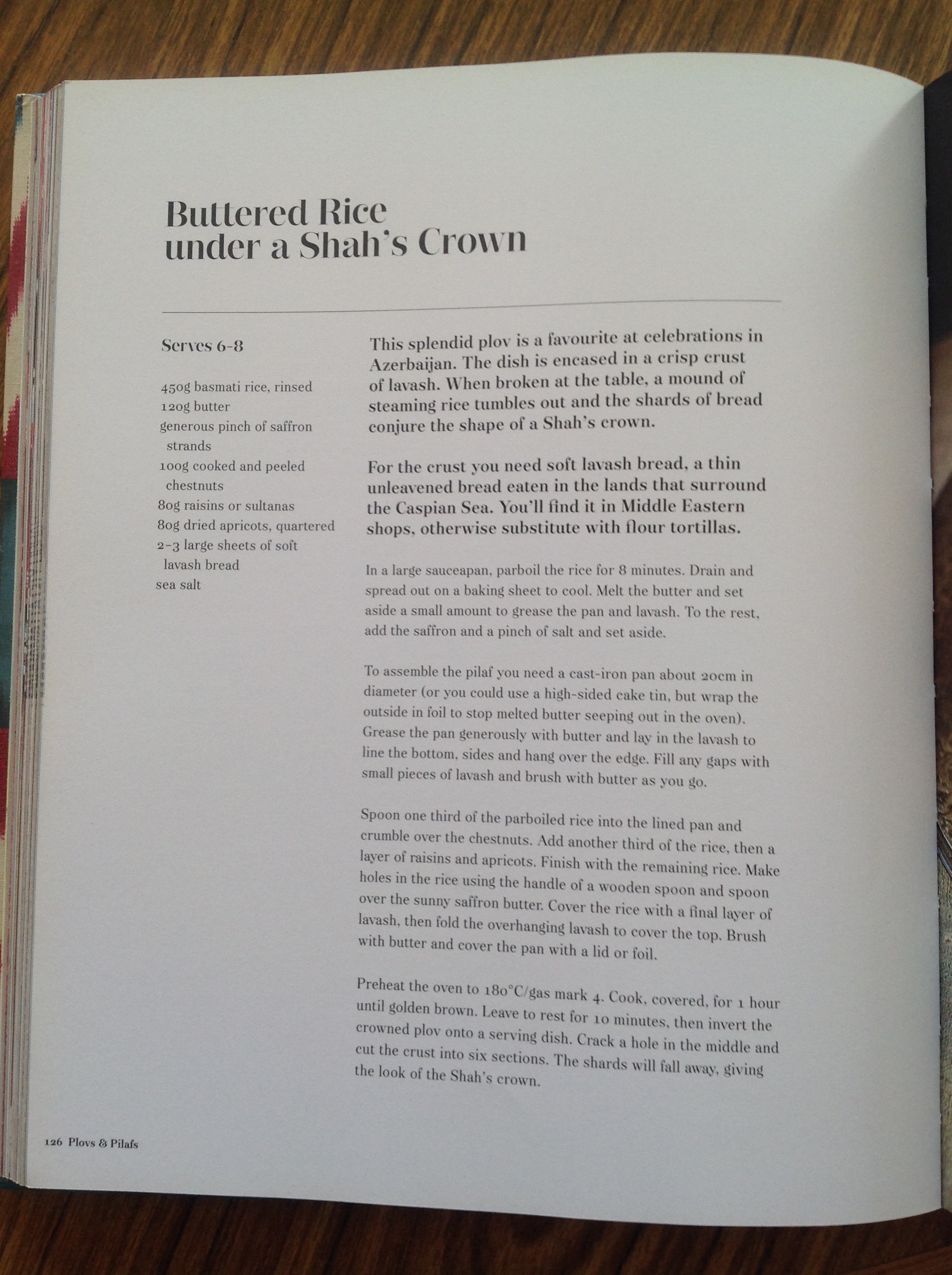
This splendid plov is a favourite at celebrations in Azerbaijan. The dish is encased in a crisp crust of lavash. When broken at the table, a mound of steaming rice tumbles out and the shards of bread conjure the shape of a Shah’s crown.
For the crust you need soft lavash bread, a thin unleavened bread eaten in the lands that surround the Caspian Sea.
Serves 6-8
Ingredients
- 450g basmati rice, rinsed
- 120g butter
- generous pinch of saffron strands
- 100g cooked and peeled chestnuts
- 80g raisins or sultanas
- 80g dried apricots, quartered
- 2–3 large sheets of soft lavash bread
- sea salt
Method
- In a large sauceapan, parboil the rice for 8 minutes. Drain and spread out on a baking sheet to cool. Melt the butter and set aside a small amount to grease the pan and lavash. To the rest, add the saffron and a pinch of salt and set aside.
- To assemble the pilaf you need a cast-iron pan about 20cm in diameter (or you could use a high-sided cake tin, but wrap the outside in foil to stop melted butter seeping out in the oven). Grease the pan generously with butter and lay in the lavash to line the bottom, sides and hang over the edge. Fill any gaps with small pieces of lavash and brush with butter as you go.
- Spoon one third of the parboiled rice into the lined pan and crumble over the chestnuts. Add another third of the rice, then a layer of raisins and apricots. Finish with the remaining rice. Make holes in the rice using the handle of a wooden spoon and spoon over the sunny saffron butter. Cover the rice with a final layer of lavash, then fold the overhanging lavash to cover the top. Brush with butter and cover the pan with a lid or foil.
- Preheat the oven to 180°C/gas mark 4. Cook, covered, for 1 hour until golden brown. Leave to rest for 10 minutes, then invert the crowned plov onto a serving dish. Crack a hole in the middle and cut the crust into six sections. The shards will fall away, giving the look of the Shah’s crown.
Photo
Chapli Kebabs
Created 2019-04-18 · Updated 2019-04-18
From Samarkand by Caroline Eden & Eleanor Ford (Kyle Books, 2016)
These Afghan spiced beef patties are so named from their flat shape, resembling a sandal or chapli. The meat is charred on the outside, juicy within and jewelled with pomegranate seeds.
Serves 6
Ingredients
For the kebabs
- 2 onions, roughly chopped
- 2 garlic cloves, crushed
- 1 knob of ginger (about the size of your thumb), peeled and grated
- 2 green chillies, deseeded
- a small bunch of coriander
- 800g minced beef
- 2 tablespoons ground coriander
- 2 teaspoons ground cumin
- 2 teaspoons garam masala
- 1 teaspoon sea salt
- seeds of 1 pomegranate
- sunflower oil, for cooking
For the tomato and pomegranate relish
- 6 very ripe plum tomatoes
- seeds of 1 pomegranate
- 1 green chilli, deseeded and finely chopped
- a handful of coriander leaves, finely chopped
- a few mint leaves, finely sliced
- 1 garlic clove, crushed
- 1 teaspoon sugar
- 1 teaspoon sea salt
- juice of ½ lemon
To serve
- lime wedges
- non bread
Method
- First make the relish. Cut the tomatoes into quarters and remove the watery seeds. Dice the flesh as finely as you can. Stir in the remaining ingredients and leave to marinate until you are ready to eat.
- To make the kebabs, put the onions, garlic, ginger, chillies and coriander in a food processor. Blitz until finely chopped, but not to a paste. Add the beef, spices and salt and pulse just to bring everything together.
- Tip the meat onto a clean surface and use your hands to mix in the pomegranate seeds. Form the meat into six large patties, about 2cm thick and, for authenticity, the shape of a sandal.
- Heat a little oil in a large frying pan. Fry the patties, in batches, for a couple of minutes, until browned on the base. Flip and cook for a minute or two longer, until cooked through to your liking. Serve with wedges of lime, non bread and the tomato and pomegranate relish.
Photo
Chicken and Almond Pilaf Pie
Created 2019-04-18 · Updated 2019-04-18
From Samarkand by Caroline Eden & Eleanor Ford (Kyle Books, 2016)
This fragrant pilaf is veiled under flaky filo pastry making it the perfect prepare-ahead dish for guests. All it needs is a salad or some sautéed greens as an accompaniment.
Serves 6-8
Ingredients
For the pie
- 1 chicken (about 1.5kg)
- 1 carrot, roughly chopped
- 1 celery stick, roughly chopped
- 3 large onions
- 150g butter
- 100g flaked almonds
- 300g long grain or basmati rice, rinsed
- 1 teaspoon ground cinnamon
- ½ teaspoon ground allspice
- ½ teaspoon freshly ground black pepper
- 3 tablespoons golden sultanas
- 6 sheets of filo pastry
- salt and freshly ground black pepper
For the saffron yogurt
- small pinch of saffron strands
- 200g Greek yogurt
- 3 tablespoons extra virgin olive oil
- 3 tablespoons lemon juice
- 1 garlic clove, crushed
Method
- First poach the chicken, which will also make a simple broth in which to cook the rice. Put the chicken in a large pan and add the carrot, celery and one of the onions, quartered but unpeeled. Pour over water, hot from the kettle, to just cover the chicken. Simmer for 1 hour, remove the bird from the meat-infused liquid and leave to cool. Shred the meat from the carcass and chill in the fridge until needed. Meanwhile, return the chicken bones to the pan and bring to the boil. Cook to reduce; you will need 500ml of hot stock in which to cook the rice. Strain and skim off any fat from the top.
- To prepare the pilaf, heat a large pan. Chop the remaining two onions and fry in 50g of the butter until soft. Add the almonds and cook, stirring often, until lightly coloured. Tip in the rice, spices and sultanas and stir to coat everything in the fat. Add 500ml of hot stock and a generous spoonful of salt. Cook, covered and undisturbed, for about 10 minutes until the liquid has been absorbed and the rice is just tender. Remove the lid and allow the rice to cool. Fork through the rice and taste for seasoning. Chill until needed.
- Melt the remaining butter and lay out the filo pastry sheets under a damp tea towel, only taking out one at a time as needed to stop the rest drying out.
- To assemble the pie, brush a 22cm springform cake tin with melted butter. Carefully line with a sheet of the filo pastry, leaving the edges hanging over the pan. Brush with butter and repeat with three more sheets of pastry, building up the layers and rotating the tin so the ragged overhang is evenly spaced around the edge. Save two pastry sheets for the top, cutting each in half to give you four squares.
- Spoon the filling into the pie. Cover with four final pastry and butter layers, then fold in the overhanging pastry and crinkle it up to create a loose, crumpled lid. Brush everything with melted butter. At this point you can chill the pie for a day before cooking.
- When you are ready to cook the pie, preheat the oven to 180°C/gas mark 4. Bake the pie on a baking sheet for 40 minutes until the top is flaky and golden. Leave to sit in the tin for 10 minutes before releasing the pie.
- While the pie is cooking, make the saffron yogurt. Put the saffron in a small bowl and pour over 4 tablespoons of water hot from the kettle. Leave to infuse for 10 minutes, then stir in the remaining ingredients. Season with salt.
- Serve the pie hot or warm with the saffron yogurt on the side.
Photo
Chicken, Potato and Prune Hotpot
Created 2019-04-18 · Updated 2019-04-18
From Samarkand by Caroline Eden & Eleanor Ford (Kyle Books, 2016)
Fruits paired with meat are a staple of Central Asia, lending both sweetness and tang. This is a homely one-pot dish, inspired by the flavours of the region.
Serves 4
Ingredients
- 4 chicken legs
- 3 tablespoons olive oil
- 450g waxy potatoes, unpeeled and cut into 2cm chunks
- 2 eating apples, unpeeled, cored and cut into 2cm chunks
- ½ teaspoon allspice
- 2 tablespoons tomato purée
- 80g prunes, stoned and halved
- 40g dried apricots, quartered
- 650ml hot chicken stock
- sea salt and freshly ground black pepper
To serve
- a small bunch of tarragon leaves
- 3 tablespoons pistachios, chopped
Method
- Season the chicken legs with salt and pepper. Heat the oil in a saucepan large enough to accommodate the chicken in a single, uncrowded layer and add the chicken legs. Brown well on both sides, then remove from the pan and set aside.
- Add the potatoes and apples and fry for 8 minutes over a medium heat, stirring occasionally. Stir in the allspice, tomato purée and dried fruits. Return the chicken legs to the pan, tucking them in among the potato and fruits.
- Pour over the chicken stock and bring to the boil. Cover with a lid, turn down the heat and simmer for 45–60 minutes, until the chicken is tender. Remove the lid for the final 10 minutes so the sauce reduces a little.
- Serve sprinkled with the tarragon and pistachios.
Photo
Dushanbe Pilaf
Created 2019-04-18 · Updated 2019-04-18
From Samarkand by Caroline Eden & Eleanor Ford (Kyle Books, 2016)
A pilaf with its roots in Dushanbe, the capital of Tajikistan. Boiled eggs are wrapped in a spiced meat coating and cooked underneath the rice, scenting the entire dish.
Serves 4
Ingredients
For the meatballs
- 4 eggs
- 1 tablespoon plain flour
- 450g minced lamb
- 1 onion, very finely chopped
- 1 teaspoon sea salt
- 1 teaspoon cumin seed
- 1 teaspoon ground coriander
- ½ teaspoon paprika
- sunflower oil, for frying
For the pilaf
- 300g basmati rice
- 75ml clarified butter
- 2 onions, chopped
- 3 carrots, cut into matchsticks
- 1 teaspoon ground cumin
- 1 teaspoon paprika
- 2 teaspoons barberries or currants
- a handful of dill fronds, chopped
- sea salt
Method
- Soak the rice in a bowl of water while you make the meatballs.
- Put the eggs in a pan of cold water and bring to the boil. Boil for 3–4 minutes, then cool in a bowl of ice-cold water. Carefully peel them. Dust the eggs with the flour.
- Mix together the lamb, onion, salt and spices with your hands until well blended. Form into 4 oval-shaped patties and carefully wrap each around a boiled egg. Squeeze the meat at the top and bottom to give the meatballs a slightly tapered shape. Chill in the fridge for 30 minutes to firm up.
- Heat the oil in a large frying pan and fry the meatballs until well browned on all sides and just cooked through. Set aside.
- To cook the pilaf you need a large pan, ideally cast iron, with a lid. Heat the clarified butter and cook the onions and carrots until softened. Add the spices and cook for a minute or two longer until the aroma hits you. At this stage add a small cup of water and the barberries.
- Lay the meatballs on top of the vegetables and cover with the drained rice. Season with salt and pour over enough boiling water to just cover the top of the rice. Increase the heat and let the water start to boil away. Once the water has cooked off, use the handle of a wooden spoon to poke holes into the rice to help the steam escape. Turn the heat down to the lowest setting and cover the pan. Cook for 5 minutes, then remove from the heat and leave to steam for a further 10 minutes, until the rice is cooked.
- To serve, mix the rice and vegetables together on a platter. Cut the meatballs into halves and lay on top. Finally, scatter the whole dish with fresh dill.
Photo
Fish and Saffron Pilaf
Created 2019-04-18 · Updated 2019-04-18
From Samarkand by Caroline Eden & Eleanor Ford (Kyle Books, 2016)
Peculiar to Western Turkmenistan is a pilaf made with fish rather than the meat ubiquitous throughout Central Asia. Sturgeon from the Caspian Sea is the usual choice, but another firm white fish such as monkfish or halibut makes a good substitute.
Serves 4
Ingredients
- 275g basmati rice
- 4 onions (1 halved and 3 thinly sliced)
- 1 tablespoon black peppercorns, crushed
- 1 bay leaf
- a small bunch of flat-leaf parsley
- 400g sturgeon, monkfish or halibut fillets
- 4 tablespoons sesame oil
- 3 carrots, sliced into matchsticks
- a small handful of dill fronds
- 1 teaspoon dill seeds
- 1 teaspoon ground black pepper
- large pinch of saffron strands, soaked in 3 tablespoons warm water
- 120g soured cream
- juice of 1 lemon
- sea salt
Method
- Put the rice in a large bowl to soak while you poach the fish.
- Bring 1 litre of water to the boil in a large pan and add the halved onion, along with the peppercorns, bay leaf and the stems from the parsley. Season well with salt and lower in the fish fillets. Cook at a very gentle simmer until just opaque through to the middle, up to 10 minutes depending on the thickness. Remove the fish with a slotted spoon and set aside. Strain and reserve the broth. You’ll use the pan again later.
- You need a second large cooking pot in which to cook the rice. Heat the sesame oil until almost smoking, then add the onions and the carrots. Stir-fry until the vegetables start to soften. Tip in the drained rice and smooth down with the back of a spoon. Pour over enough of the fish broth to cover the top of the rice by about 1cm and salt generously. Bring to the boil and cook over a high heat until the broth has boiled off. Use the spoon handle to poke a few holes in the rice to help release the steam. Cover with a lid or tight-fitting layer of foil and remove from the heat. Leave to steam for 20 minutes for the rice to cook through.
- Chop the parsley leaves and dill fronds and add to the empty fish pan. Add the dill seeds, black pepper, the saffron and its soaking liquid and season with salt. Stir in the soured cream and set over a low heat to warm through. Carefully add the fish fillets to warm through in the saffron cream before serving.
- Turn the rice onto a large platter and squeeze over the lemon. Spoon the fish and its creamy sauce on top.
Photo
Georgian Chicken with Walnut Sauce
Created 2019-04-18 · Updated 2019-04-18
From Samarkand by Caroline Eden & Eleanor Ford (Kyle Books, 2016)
Garo is a herby walnut sauce made with fenugreek seeds, which give it an unusual but intriguing flavour. This sauce is ubiquitous in Georgian cooking, served with meat, fish, vegetables and even eggs. It works particularly well with roast chicken.
Serves 4
Ingredients
- 1 chicken (about 1.5kg)
- 1 teaspoon ground coriander
- ½ teaspoon cayenne pepper
- 2 tablespoons olive oil
- ½ lemon
- sea salt and freshly ground black pepper
For the walnut sauce
- 20g coriander leaves
- 60g walnuts
- 2 garlic cloves, crushed
- 1 teaspoon fenugreek seeds, roughly ground
- ½ teaspoon ground coriander
- ½ teaspoon ground turmeric
- juice of ½ lemon
- 150ml hot chicken stock or water
Method
- Preheat the oven to 190°C/gas mark 5.
- Season the chicken inside and out and dust over the ground coriander and cayenne. Drizzle with the olive oil and use your hands to rub the oil and spices into the skin well. Squeeze over the lemon juice and put the squeezed out lemon into the cavity. Place the chicken in a roasting tin and roast for 1 hour 10 minutes, or until the juices run clear.
- Meanwhile, make the sauce. Put all the ingredients, except the stock, into a food processor and whizz to a paste. Pour in the chicken stock with the motor running. Transfer to a pan and simmer for 10 minutes, stirring often. Remove from the heat, leave to cool to room temperature and taste for seasoning.
- Serve the chicken hot or cold with the walnut sauce.
Photo
Green-herbed Plov with Chickpeas
Created 2019-04-18 · Updated 2019-04-18
From Samarkand by Caroline Eden & Eleanor Ford (Kyle Books, 2016)
Vegetarianism is still rather an alien concept in Central Asia and it is hard to find a plov without meat as its central component. However, in Bukhara they cook a springtime plov using lots of wonderful fresh greens, which lends itself to this meat-free adaptation. A layer of herbs and spinach steams in the middle of the pan, scenting the rice above. You can substitute any greens and herbs you like
Serves 4
Ingredients
- 100g butter
- 3 onions, sliced
- 1 fennel bulb, sliced, any fronds saved and added to the herbs
- 1 teaspoon paprika
- ½ teaspoon ground coriander
- ½ teaspoon ground cumin
- ½ teaspoon cayenne pepper
- 400g can chickpeas, drained and rinsed
- 3 garlic cloves, roughly chopped
- 75g black olives, stoned and roughly chopped
- 300g spinach, washed
- a large bunch of flat-leaf parsley, leaves only
- a small bunch of coriander, leaves only
- a handful of celery leaves
- a handful of dill fronds
- 350g basmati rice, rinsed
- juice of 1 lemon
- sea salt
Method
- Heat the butter in a large heavy-bottomed casserole pan and cook the onions and fennel until softened. Stir in the spices and cook for a minute longer. Scatter the chickpeas, garlic and olives on top in a layer, without stirring, and add a small cupful of water.
- Chop the spinach leaves along with half the herbs and layer these over the chickpeas. Press down with a spoon as the steam begins to wilt and collapse the greens. Flatten the greens into a layer and tip over the drained rice, smoothing the surface with the back of a spoon. Season generously with salt. Pour over enough boiling water to just cover the rice. Cook over a high heat until the liquid has boiled off. Use the handle of a wooden spoon to poke a few holes into the rice to allow the steam to escape. Cover the pan with a lid or foil and turn off the heat. Leave the rice to steam for 20 minutes.
- Chop the remaining herbs. Spoon the plov onto a serving dish, carefully mixing together the layers along with the extra herbs. Spritz over the lemon juice and taste for seasoning.
Photo
Kazan Kebab
Created 2019-04-18 · Updated 2019-04-18
From Samarkand by Caroline Eden & Eleanor Ford (Kyle Books, 2016)
In most of Uzbekistan, the name of this dish refers to lamb cooked with potatoes in a kazan (a large wok-like pan). However, in the Fergana Valley, a fertile region that straddles Uzbekistan, Tajikistan and Kyrgyzstan, a kazan kebab is the name of a delicious hearty meat and chickpea soup. This is home cooking, not something you’ll find in restaurants.
Serves 4
Ingredients
- 400g blade stewing steak, cut into cubes
- 1 tablespoon plain flour
- 2 tablespoons clarified butter or sunflower oil
- 3 garlic cloves, crushed
- 500g tomato passata
- 1 bay leaf
- 400g can chickpeas, drained and rinsed
- a small bunch of coriander, leaves, torn
- 1 tablespoon torn basil leaves
- 1 tablespoon fresh oregano leaves
- 1 tablespoon chopped dill fronds
- juice of ½ lemon
- sea salt and freshly ground black pepper
To serve
- lemon wedges
- sliced fresh chilli
Method
- Toss the beef in the flour and season with salt and pepper. Heat the clarified butter in a large casserole pan and brown the beef, in batches if necessary. Add the garlic and cook, stirring, for a couple of minutes, then add the passata, bay leaf and 500ml water. Bring to the boil, then turn down the heat and cover the pan. Simmer for 1 hour, stirring occasionally, or until the meat is tender.
- Stir in the chickpeas, herbs and lemon juice and taste for seasoning. Simmer for a further 10 minutes before serving with wedges of lemon and sliced chilli to add at the table.
Photo
Kyrgyz Swirled Onion Flatbread
Created 2019-04-18 · Updated 2019-04-18
From Samarkand by Caroline Eden & Eleanor Ford (Kyle Books, 2016)
Flaky fried breads are popular in Kyrgyzstan, where they are served hot from the pan alongside soup. These flatbreads, called katama, can be made with or without yeast in the dough, but the sweet and slightly spicy caramelised onion is essential.
Makes 4
Ingredients
- 50g butter
- 2 small onions, finely sliced
- pinch of chilli powder
- 200g plain flour, plus extra for dusting
- sunflower oil, for cooking
- sea salt
Method
- Heat the butter in a small heavy-bottomed frying pan over a medium heat. Fry the onions with a pinch of salt, stirring often, until very soft and golden brown. Season with the chilli powder and set aside to cool.
- Put the flour in a large bowl with 1/2 teaspoon of salt and make a well in the centre. Squeeze the onions using the back of a spoon and add any butter that comes out to the flour. Start trickling in 100ml warm water into the well while you mix with your other hand. Bring the dough together and knead for a good couple of minutes. You want dough that is soft and pliable – if it is too dry, add a splash of water or if it is too sticky, add a little more flour.
- Divide the dough into four equal pieces. Roll out each piece thinly on a floured surface and spread a quarter of the onion over the surface. Roll up into a tube, pinch the ends and form the tube into a coil with the outside end tucked underneath. It should resemble a cinnamon roll. Finally, roll it flat again into cardboard-thin rounds. Repeat with the remaining dough. The rounds will contract as they sit so you’ll need to pull them out a little flatter with your hands as you take them to the pan.
- Heat a frying pan over a medium-high heat and use kitchen paper to rub it with a little oil. Fry the breads for about 2 minutes on each side, turning after each minute. They should puff up a little and begin to blister as they cook. Serve hot from the pan.
Photo
Melting Potatoes with Dill
Created 2019-04-18 · Updated 2019-04-18
From Samarkand by Caroline Eden & Eleanor Ford (Kyle Books, 2016)
Long, slow cooking in butter and only their own steam for liquid make these potatoes silky soft inside and caramelised on the outside.
Serves 4
Ingredients
- 50g butter
- 2 tablespoons olive oil
- 2 onions, sliced
- 500g waxy potatoes, unpeeled and cut into 1cm slices
- 3 garlic cloves, finely sliced
- 1 teaspoon cracked black peppercorns
- a small handful of dill fronds, chopped
- sea salt
Method
- Heat the butter and oil in a large frying pan and cook the onions very slowly until soft and golden. Add the potato slices and garlic and stir to gloss them with the buttery onions. Season well with salt and cover with a lid or foil.
- Leave the potatoes to cook over the lowest heat, stir occasionally, then replace the lid or foil, for about 45 minutes. Stir through the peppercorns and a handful of fresh dill before serving.
Photo
Note
Created 2019-04-18 · Updated 2019-04-18
(empty note)
Note
Created 2019-04-18 · Updated 2019-04-18
(empty note)
Note
Created 2019-04-18 · Updated 2019-04-18
(empty note)
Pistachio Halva
Created 2019-04-18 · Updated 2019-04-18
From Samarkand by Caroline Eden & Eleanor Ford (Kyle Books, 2016)
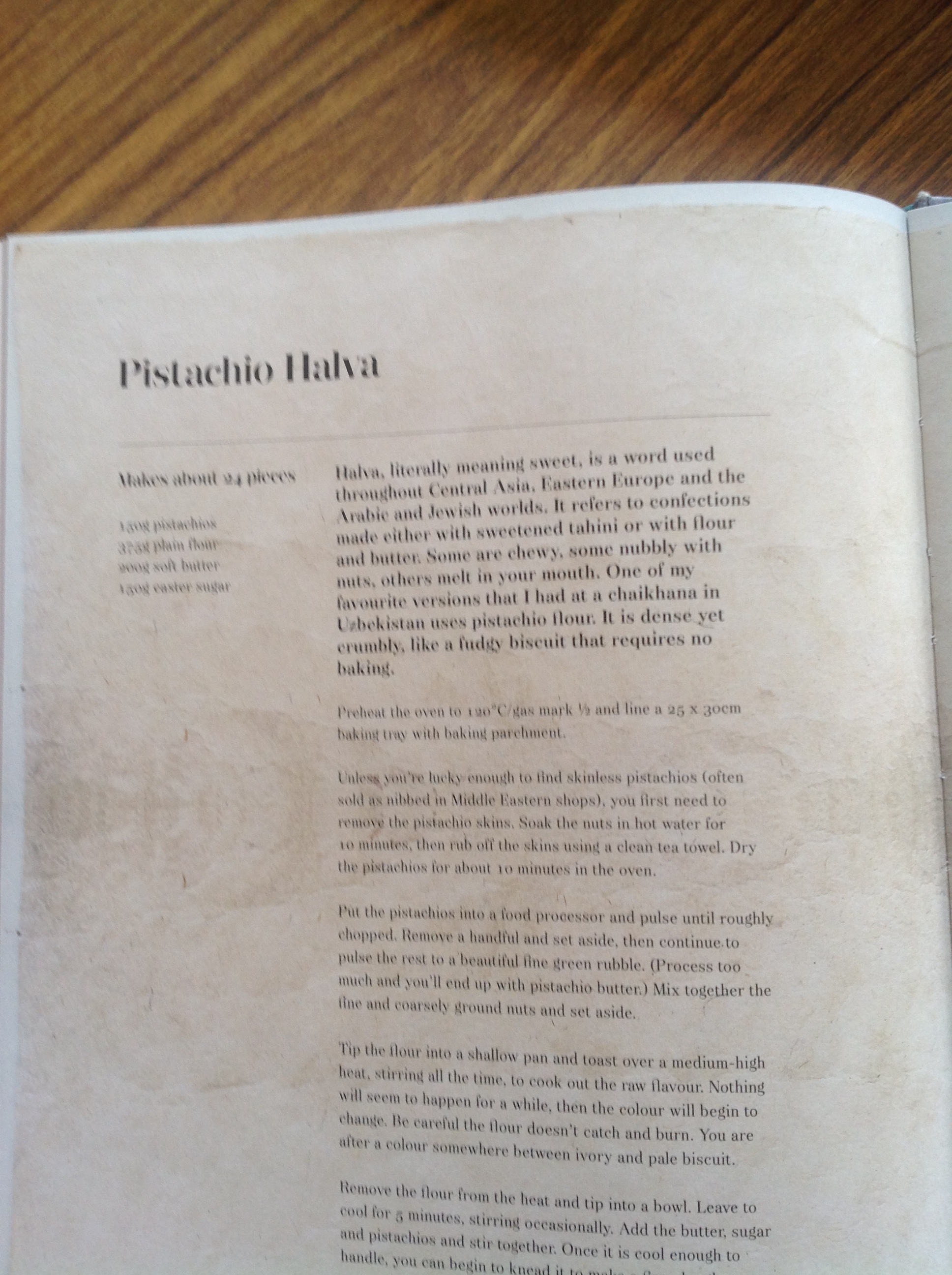
Halva, literally meaning sweet, is a word used throughout Central Asia, Eastern Europe and the Arabic and Jewish worlds. It refers to confections made either with sweetened tahini or with flour and butter. Some are chewy, some nubbly with nuts, others melt in your mouth. One of my favourite versions that I had at a chaikhana in Uzbekistan uses pistachio flour. It is dense yet crumbly, like a fudgy biscuit that requires no baking.
Makes about 24 pieces
Ingredients
- 150g pistachios
- 375g plain flour
- 200g soft butter
- 150g caster sugar
Method
- Preheat the oven to 120°C/gas mark ½ and line a 25 x 30cm baking tray with baking parchment.
- Unless you’re lucky enough to find skinless pistachios (often sold as nibbed in Middle Eastern shops), you first need to remove the pistachio skins. Soak the nuts in hot water for 10 minutes, then rub off the skins using a clean tea towel. Dry the pistachios for about 10 minutes in the oven.
- Put the pistachios into a food processor and pulse until roughly chopped. Remove a handful and set aside, then continue to pulse the rest to a beautiful fine green rubble. (Process too much and you’ll end up with pistachio butter.) Mix together the fine and coarsely ground nuts and set aside.
- Tip the flour into a shallow pan and toast over a medium-high heat, stirring all the time, to cook out the raw flavour. Nothing will seem to happen for a while, then the colour will begin to change. Be careful the flour doesn’t catch and burn. You are after a colour somewhere between ivory and pale biscuit.
- Remove the flour from the heat and tip into a bowl. Leave to cool for 5 minutes, stirring occasionally. Add the butter, sugar and pistachios and stir together. Once it is cool enough to handle, you can begin to knead it to make a firm dough.
- Press the dough into the lined tray, first with your fingers, then using the back of a spoon to really compress it together. It will seem very crumbly but don’t worry; it will firm as it sets. Use a knife to score the halva into diamonds and put the tray into the fridge to chill overnight.
- Slice along the score lines before serving. Store in the fridge. It makes a perfect pairing for one of the Spice Teas.
Photo
Pomegranate Soup
Created 2019-04-18 · Updated 2019-04-18
From Samarkand by Caroline Eden & Eleanor Ford (Kyle Books, 2016)
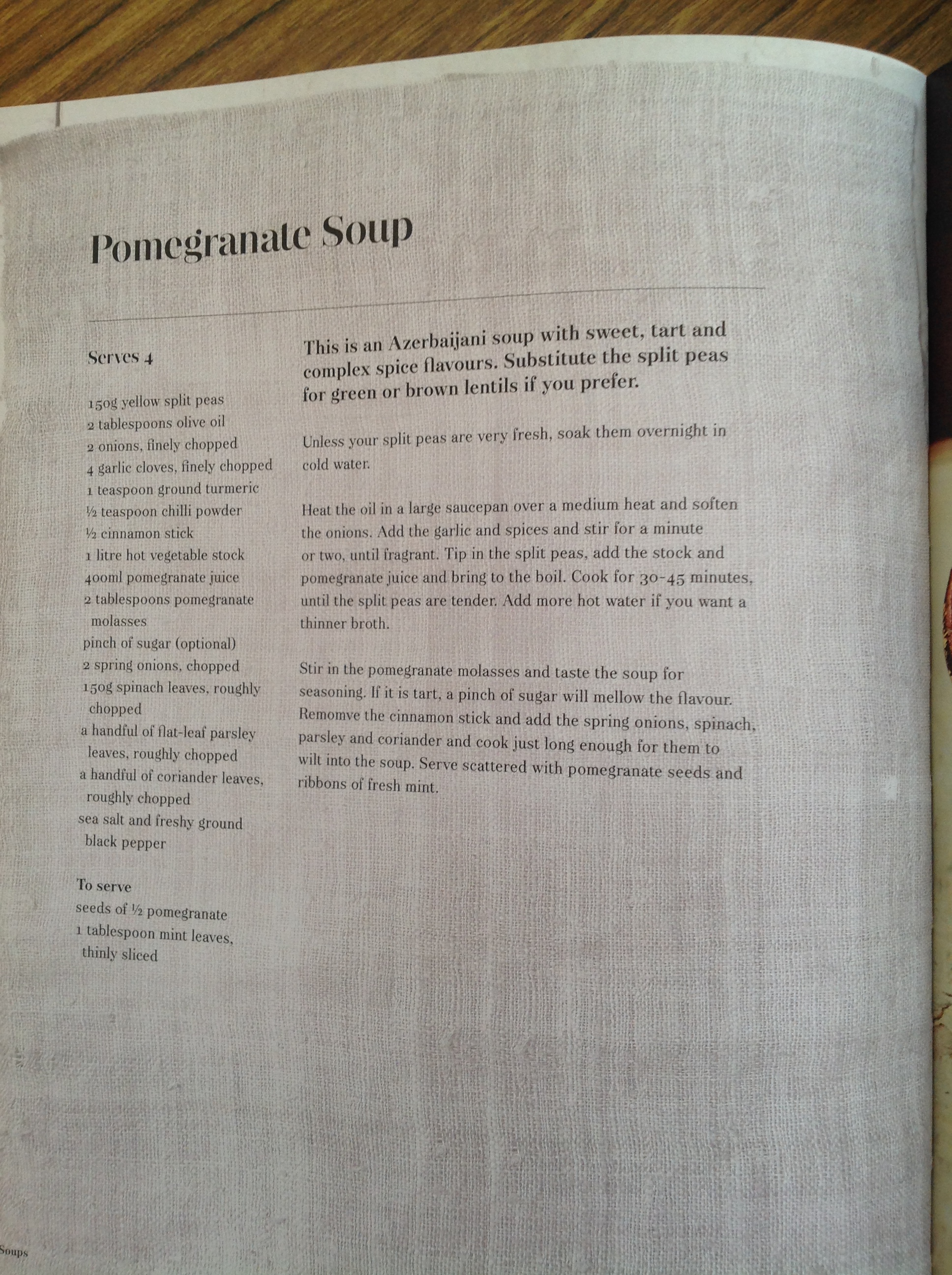
This is an Azerbaijani soup with sweet, tart and complex spice flavours. Substitute the split peas for green or brown lentils if you prefer.
Serves 4
Ingredients
- 150g yellow split peas
- 2 tablespoons olive oil
- 2 onions, finely chopped
- 4 garlic cloves, finely chopped
- 1 teaspoon ground turmeric
- ½ teaspoon chilli powder
- ½ cinnamon stick
- 1 litre hot vegetable stock
- 400ml pomegranate juice
- 2 tablespoons pomegranate molasses
- pinch of sugar (optional)
- 2 spring onions, chopped
- 150g spinach leaves, roughly chopped
- a handful of flat-leaf parsley leaves, roughly chopped
- a handful of coriander leaves, roughly chopped
- sea salt and freshy ground black pepper
To serve
- seeds of ½ pomegranate
- 1 tablespoon mint leaves, thinly sliced
Method
- Unless your split peas are very fresh, soak them overnight in cold water.
- Heat the oil in a large saucepan over a medium heat and soften the onions. Add the garlic and spices and stir for a minute or two, until fragrant. Tip in the split peas, add the stock and pomegranate juice and bring to the boil. Cook for 30-45 minutes, until the split peas are tender. Add more hot water if you want a thinner broth.
- Stir in the pomegranate molasses and taste the soup for seasoning. If it is tart, a pinch of sugar will mellow the flavour. Remomve the cinnamon stick and add the spring onions, spinach, parsley and coriander and cook just long enough for them to wilt into the soup. Serve scattered with pomegranate seeds and ribbons of fresh mint.
Photo
Roasted Cauliflower with Pistachio and Tarragon
Created 2019-04-18 · Updated 2019-04-18
From Samarkand by Caroline Eden & Eleanor Ford (Kyle Books, 2016)
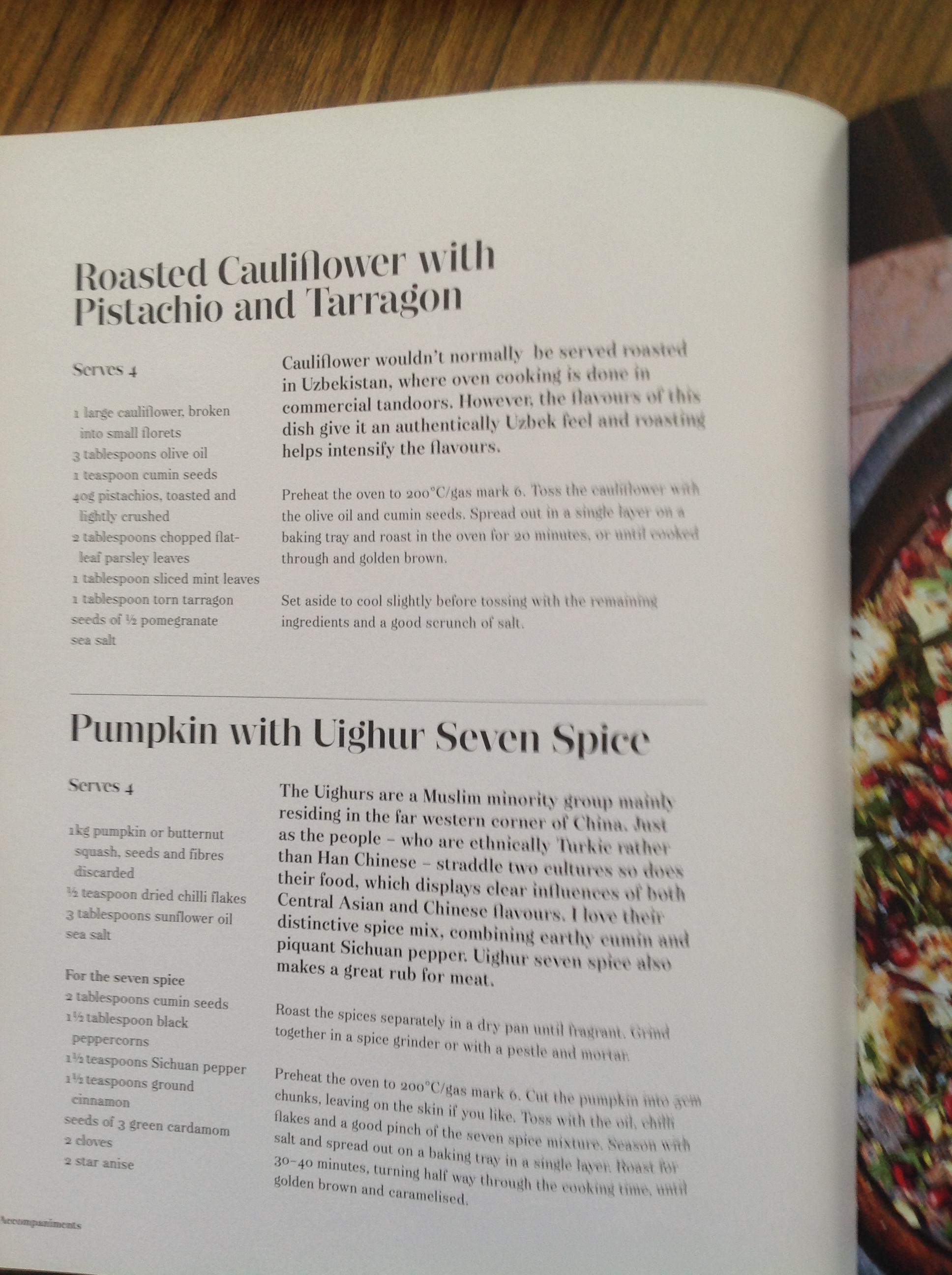
Cauliflower wouldn’t normally be served roasted in Uzbekistans. However, the flavours of this dish give it an authentically Uzbek feel and roasting helps intensify the flavours.
Serves 4
Ingredients
- 1 large cauliflower, broken into small florets
- 3 tablespoons olive oil
- 1 teaspoon cumin seeds
- 40g pistachios, toasted and lightly crushed
- 2 tablespoons chopped flat-leaf parsley leaves
- 1 tablespoon sliced mint leaves
- 1 tablespoon torn tarragon
- seeds of ½ pomegranate
- sea salt
Method
- Preheat the oven to 200°C/gas mark 6. Toss the cauliflower with the olive oil and cumin seeds. Spread out in a single layer on a baking tray and roast in the oven for 20 minutes, or until cooked through and golden brown.
- Set aside to cool slightly before tossing with the remaining ingredients and a good scrunch of salt.
Photo
Ruins of a Russian Count’s Castle
Created 2019-04-18 · Updated 2019-04-18
From Samarkand by Caroline Eden & Eleanor Ford (Kyle Books, 2016)
This magnificently named cake is a Russian creation and very popular for celebrations in Uzbekistan. There are many different versions including meringue, sponge, even profiteroles, but always piled into precarious towers like the crumbling ruins of a hilltop castle.
Makes 1 cake
Ingredients
For the meringues
- 2 large egg whites (about 80g)
- 75g caster sugar
- 50g icing sugar, sieved
- 2 teaspoons cocoa powder, sieved
For the cake
- 100g dried prunes, stoned and roughly chopped
- 50g walnuts, roughly chopped
- 75g plain flour
- 1½ teaspoons baking powder
- 75g soft butter, plus extra for greasing
- 75g caster sugar
- 1 extra large egg
- 50g dark chocolate, for decorating
For the cream
- 200ml double cream
- 200ml soured cream
Method
- Start by making the meringues. Preheat the oven to 100°C/gas mark 1/4. Line two baking trays with baking parchment.
- Whisk the egg whites to the soft peak stage and add the caster sugar, a spoonful at a time, whisking until the mixture is thick, very glossy and very smooth. Fold in the icing sugar, add the cocoa and fold until the chocolate brown just ripples through the white. Spoon or pipe the mixture into meringues about 4cm in diameter on the parchment paper. Bake for 1 hour, or until firm and crisp. Cool and store in an airtight tin until needed.
- To make the cake, preheat the oven to 170°C/gas mark 3. Grease and line a 20cm cake tin.
- Start by mixing the prunes and walnuts with a small spoonful of the flour, just to give them a dusty coating. Set aside. Sift the remaining flour and the baking powder into a roomy mixing bowl. Add the butter, sugar and egg and, using an electric whisk, mix for about a minute until smooth and creamy. Use a metal spoon to fold the prunes and nuts into the mixture and spread the mixture into the cake tin. Bake for 25 minutes, or until the cake is springy to the touch. Turn out onto a rack and leave to cool completely.
- To make the cream, beat the two creams together until they just form stiff peaks. Spread the top and sides of the cake with some of the cream. Roughly crumble 4 or 5 of the meringues into the remaining cream and fold together. Pile this mixture in a mound on top of the cake. Position the remaining meringues into the cream to cover the surface.
- For a final flourish, melt the chocolate in a heatproof bowl over a pan of simmering water. Leave to cool, then drizzle over the top.
Photo
Salmon Kulebyaka
Created 2019-04-18 · Updated 2019-04-18
From Samarkand by Caroline Eden & Eleanor Ford (Kyle Books, 2016)
In Russia, pies (pirogi) come in many shapes and sizes. Sometimes the dough is leavened, other times not, while the pie may be open or closed. Inside the pie – which could be triangular, round or square – you’ll find fillings ranging from meat and mushrooms to cabbage and cheese. One of the very finest is the kulebyaka (or coulibiac in French), a fully enclosed salmon and rice pie – robust, golden-brown and crusty. It can be made well in advance.
Serves 6
Ingredients
- 50g butter
- 300g boneless, skinless salmon fillets
- 1 onion, finely chopped
- 1 teaspoon coriander seeds
- 1 teaspoon cumin seeds
- ½ teaspoon ground turmeric
- seeds of 2 green cardamom pods
- 150g mushrooms, sliced
- zest of 1 unwaxed lemon
- 3 tablespoons flat-leaf parsley leaves
- 3 tablespoons chopped dill fronds
- 100g cooked basmati rice
- 500g puff pastry
- 3 hard-boiled eggs, peeled and sliced
- 1 egg, beaten
- sea salt and freshly ground black pepper
For the sauce
- 75g butter
- juice of 1 lemon
- 2 teaspoons chopped dill fronds
Method
- Melt half the butter in a frying pan over a medium heat and cook the salmon fillets for 2–3 minutes on each side. Lift out the fillets and set aside to cool. Add the remaining butter to the pan and cook the onion for 10 minutes until soft and turning golden. Stir in the spices and mushrooms and cook for 5 minutes. Remove from the heat and leave to cool before stirring through the lemon zest, herbs, salt and pepper. Finally add the cooked rice and mix through gently.
- For the pie, roll out the puff pastry to a 40cm square. Cut it into two pieces, one slightly wider than the other. Line a baking tray with parchment and lay the narrower strip of pastry on it. Spoon over two-thirds of the rice mixture, leaving a border. Flake over the salmon, top with the egg slices and then the remaining rice.
- Brush a little beaten egg over the pastry border. Drape the larger piece of pastry over the top and press the edges to seal the two sheets together, crimping with your fingers or pressing down with the tines of a fork. Score the top with the back of a knife or prick with a non bread stamp, then glaze with beaten egg. This can now be chilled until you are ready to cook.
- Preheat the oven to 220°C/gas mark 7. Bake for 25–30 minutes until golden brown. Leave to rest for 10 minutes before slicing thickly to serve.
- For the sauce, melt the butter and add the lemon juice and dill. Bring a jug of the sauce to the table to drizzle over the kulebyaka.
Photo
Samarkand Plov
Created 2019-04-18 · Updated 2019-04-18
From Samarkand by Caroline Eden & Eleanor Ford (Kyle Books, 2016)
The quintessential dish of Uzbekistan, with as many variants as there are people who cook it. This Samarkand version is a little lighter than most traditional Uzbek plovs, where pools of lamb tail fat provide the dominant flavour. It can be made with lamb or beef and is distinctive for being cooked and served in layers.
Plov should be eaten from one large dish placed on the table to share, each diner digging in their fork. It is said people form mutual love from a communal plate and the joy of eating plov.
Serves 6
Ingredients
- 450g basmati rice, rinsed
- 600g blade stewing steak, diced
- 150ml clarified butter or sunflower oil
- 4 onions, cut into wedges
- 2 bay leaves
- 4 yellow and 2 orange carrots (or use 6 orange), cut into thick matchsticks
- 1 teaspoon cumin seeds
- ½ teaspoon black pepper
- ½ teaspoon cayenne pepper
- ½ teaspoon paprika
- 12 garlic cloves, unpeeled
- 12 hard-boiled quail’s eggs, peeled
- salt and freshly ground black pepper
Method
- You’ll need a good, heavy-bottomed pan with a close-fitting lid to make plov. In Uzbekistan, a cast-iron kazan is used; a large cast-iron casserole makes the perfect substitute.
- Put the rinsed rice into a large bowl of cold water to soak while you start the recipe. Season the beef with salt and pepper.
- Heat the clarified butter in the pan until hot and foaming. Brown the beef over a medium-high heat, in batches if necessary, then remove from the pan with a slotted spoon leaving the butter behind. Lower the heat to medium and add the onions. Cook, stirring occasionally, until softened and golden. Return the beef to the pan with any collected juices, the bay leaves and a small cupful of water. Bring to the boil, then turn the heat down very low, cover the pan and gently simmer for 1 hour until the meat is tender.
- Spread over the carrot matchsticks, but don’t stir as you want to keep the layers separate. Scatter over the spices, and cover and cook for a further 10 minutes.
- Drain the rice and layer it on top of the carrots. Poke the whole garlic cloves into the rice and flatten the top with the back of a spoon. Season very generously with salt and slowly pour over enough boiling water to just cover the top of the rice. Increase the heat and leave the pan uncovered so that the water starts to boil away.
- When the liquid has cooked off, make six holes in the rice using the handle of a wooden spoon to help the steam escape. Cover the pan and cook at a low simmer for 5 minutes. Turn off the heat without removing the lid and leave the dish to steam undisturbed for a further 10 minutes. If the rice isn’t cooked, add a splash more boiling water and cover again.
- Serve the layers in reverse, first spooning the rice onto the platter, then the carrots and finally the tender chunks of meat on the top. Circle the hard-boiled quail’s eggs around the edge. A juicy tomato salad is the perfect accompaniment.
Rosh Hashanah Plov with Barberries, Pomegranate and Quince
A festival in Central Asia demands a large gathering and of course a large plov. While the previous recipe is for an everyday plov, it can be easily transformed to one that is celebratory, studded with fruits and spices. For Bukharan Jews, the autumn festival of Rosh Hashanah (the Jewish New Year) is a perfect occasion to use glorious quince and pomegranate at the height of their season.
- Using the Samarkand Plov recipe, choose either beef or cubed leg of lamb. Add 1 teaspoon ground cumin and 1 teaspoon ground allspice to the pan with the onions. When you return the meat to the pan, add 2 quinces, cut into wedges and cored. Along with the rice, tuck in a couple of cinnamon sticks and scatter over 60g dried barberries or currants. Cook as above, then serve with fresh pomegranate seeds rained over the top instead of the quail’s eggs.
Photo
Samarkand Plov (page 2)
Created 2019-04-18 · Updated 2019-04-18
More photos of Samarkand Plov; the full recipe text is there.
Photo
Samsa
Created 2019-04-18 · Updated 2019-04-18
From Samarkand by Caroline Eden & Eleanor Ford (Kyle Books, 2016)
These meaty Uzbek pastries share an etymological and culinary heritage with Indian samosas. Cooked on the walls of portable tandoor ovens in bustling market squares, you can buy them to eat hot within your fingers.
Makes 12 small samsa
Ingredients
- 1 small onion, roughly chopped
- 200g minced lamb
- ½ teaspoon ground cumin
- ½ teaspoon sea salt
- ¼ teaspoon black pepper
- 320g pack of puff pastry
- 1 small egg, beaten
- 1 teaspoon black sesame seeds
Method
- Put the onion in a food processor and pulse until very finely chopped. Add the minced lamb, cumin, salt and pepper and pulse again to bring the mixture together.
- Roll out the pasty to a rectangle 24 x 32cm and use an 8cm cutter to stamp out 12 rounds. Drop a spoonful of the mince mixture onto each round, then bring up three sides and pinch together well to make a triangle. Repeat with the remaining pastry.
- Put the triangles seam-side down on a baking tray. Brush the pastry with beaten egg and sprinkle with the black sesame seeds. Chill until ready to cook.
- Preheat the oven to 220°C/gas mark 7.
- Bake for 20 minutes until the pastry is golden and the filling cooked through.
Photo
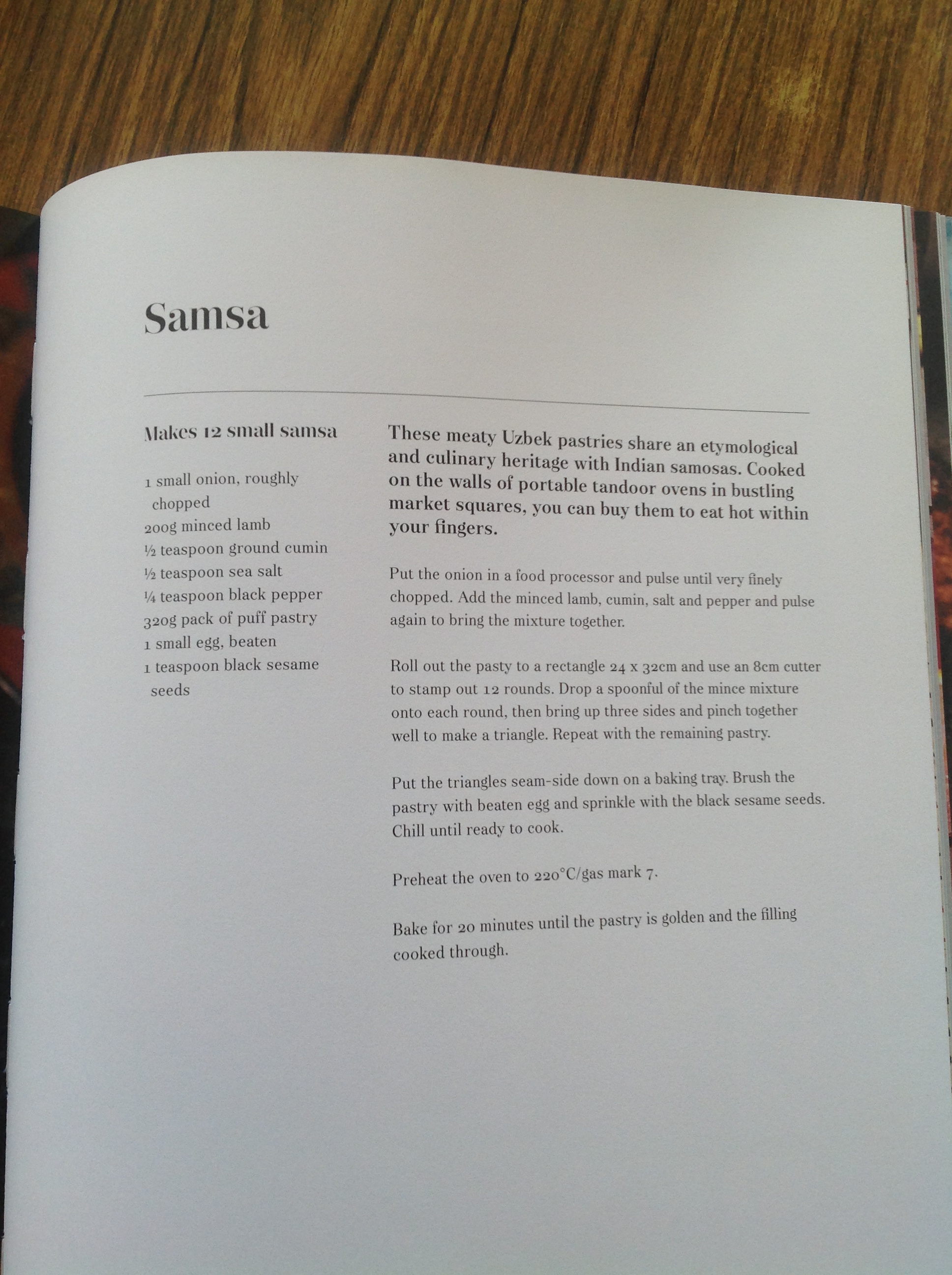
Sesame, Almond and Ginger Brittle
Created 2019-04-18 · Updated 2019-04-18
From Samarkand by Caroline Eden & Eleanor Ford (Kyle Books, 2016)
Sesame brittle is a popular sweet in Uzbekistan and this version with almonds and ginger is so moreish. Bicarbonate of soda aerates and lightens the caramel, while crystallised ginger gives a little chew alongside the snap.
Makes about 25-30 pieces
Ingredients
- 180g sugar
- 4 tablespoons honey
- 120g sesame seeds
- 100g whole blanched almonds
- 25g butter
- 60g crystallised ginger, roughly chopped
- 1 scant teaspoon bicarbonate of soda
Method
- Line a baking tray with baking parchment.
- Put the sugar, honey and 80ml water into a pan and cook gently without stirring until the sugar melts. Turn up the heat to high and tip in the sesame seeds and almonds. Cook, stirring almost continuously, as the sugar first bubbles then begins to caramelise and darken. Continue stirring until the seeds and sugar are a rich caramel colour, then remove from the heat.
- Mix in the butter and, once it has melted and been fully incorporated, add the crystallised ginger, then the bicarbonate of soda, which will make the mixture foam a little. Pour onto the tray and use the back of a spoon to smooth it out to about 2cm thick. It will make a rectangle roughly 20 x 28cm. Leave to cool completely.
- Turn onto a cutting board and cut into squares. Store in an airtight container. It will last for ages but does get a little sticky with time.
Photo
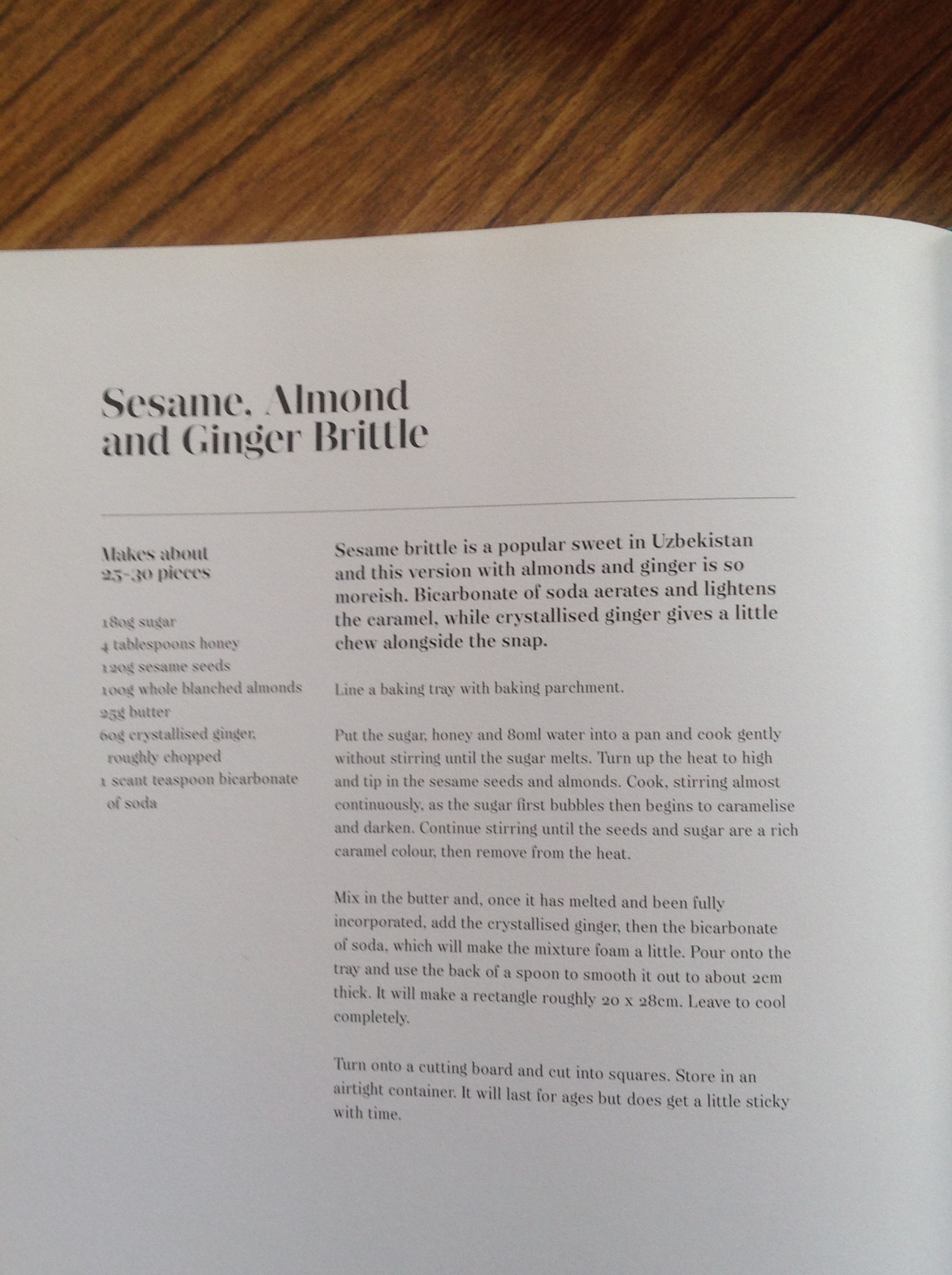
Slow-roast Mutton with Sultan’s Delight
Created 2019-04-18 · Updated 2019-04-18
From Samarkand by Caroline Eden & Eleanor Ford (Kyle Books, 2016)
The dish that so delighted the Ottoman Sultan Murad IV back in the seventeenth century was a silky mound of cheesy aubergine purée – hunkar begendi. If you don’t incline towards roast mutton, it is equally enchanting served with lamb chops.
Serves 4-6
Ingredients
For the mutton
- 250g unsalted butter, softened
- 1 teaspoon sea salt
- 1 teaspoon ground cumin
- 1 teaspoon ground cinnamon
- ½ teaspoon cayenne pepper
- ½ teaspoon caraway seeds
- 4 garlic cloves, crushed
- 1 shoulder of mutton on the bone, about 2.5kg
- 12 shallots, peeled and halved
- 2 heads of garlic, unpeeled and halved across the centre
For the sultan’s delight
- 2 aubergines
- olive oil, for rubbing
- 35g butter
- 35g plain flour
- 250ml milk
- 100g hard cheese (such as Cheddar), grated
- pinch of grated nutmeg
Method
- Preheat the oven to 140°C/gas mark 1½.
- Make a spice paste for the mutton by blending together the butter, salt, spices and crushed garlic. Slather this all over the meat. Put the shallots and garlic halves in a deep roasting tin and sit the mutton on top. Pour in 750ml cold water, or enough to come up to the bottom of the meat. Cover with foil and cook in the oven for 6 hours, or until the meat is completely tender.
- While the mutton is cooking, prepare the sultan’s delight. Put the whole aubergines in a separate roasting tin, drizzle with a little olive oil and transfer to the oven with the lamb. Cook for 1 hour, or until softened. Leave to cool.
- Melt the butter in a pan over a low heat. Add the flour and stir continuously until the mixture turns pale golden. Take the pan off the heat and add the milk, slowly at first, making sure the liquid is well mixed in before you add more. Return to the heat and bring to the boil, stirring continuously until the sauce has thickened. Turn the heat down and leave to simmer for 5 minutes. Stir in the cheese and the nutmeg.
- Peel the aubergines and put the pulp in a sieve. Gently squeeze out any liquid. Add the aubergine to the cheese sauce and taste for seasoning.
- When the meat is tender, remove the foil, turn the oven up to 200°C/gas mark 6 and brown the meat for 20 minutes. Rest the meat and strain the juices into a saucepan and reduce a little. Serve the mutton with the sultan’s delight and the pan juices.
Photo
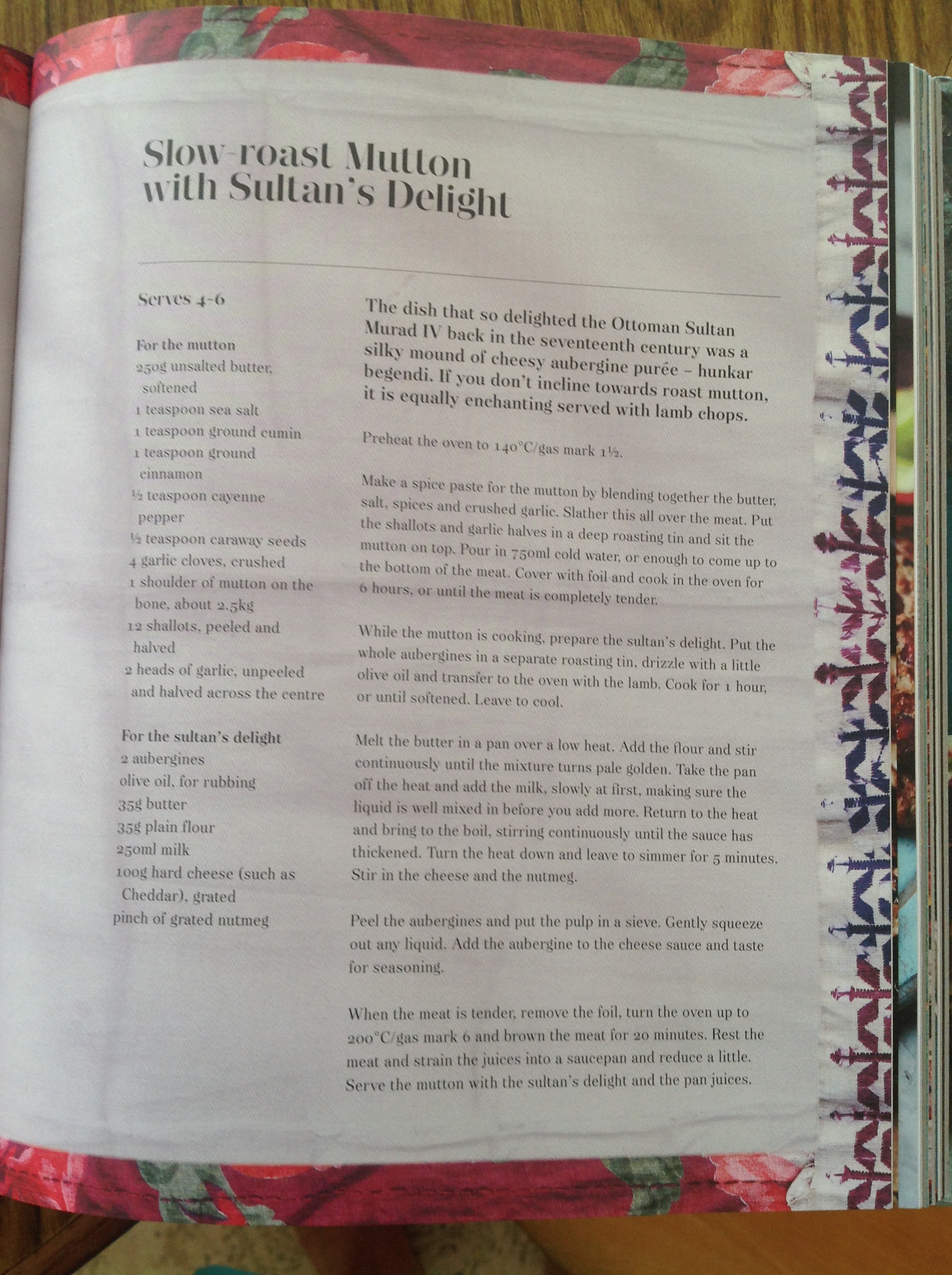
Spicy Meatballs and Shah’s Crown (more photos)
Created 2019-04-18 · Updated 2019-04-18
More photos of Spicy Meatballs with Adjika and Yogurt and Buttered Rice under a Shah’s Crown; the full recipe text is there.
Photos
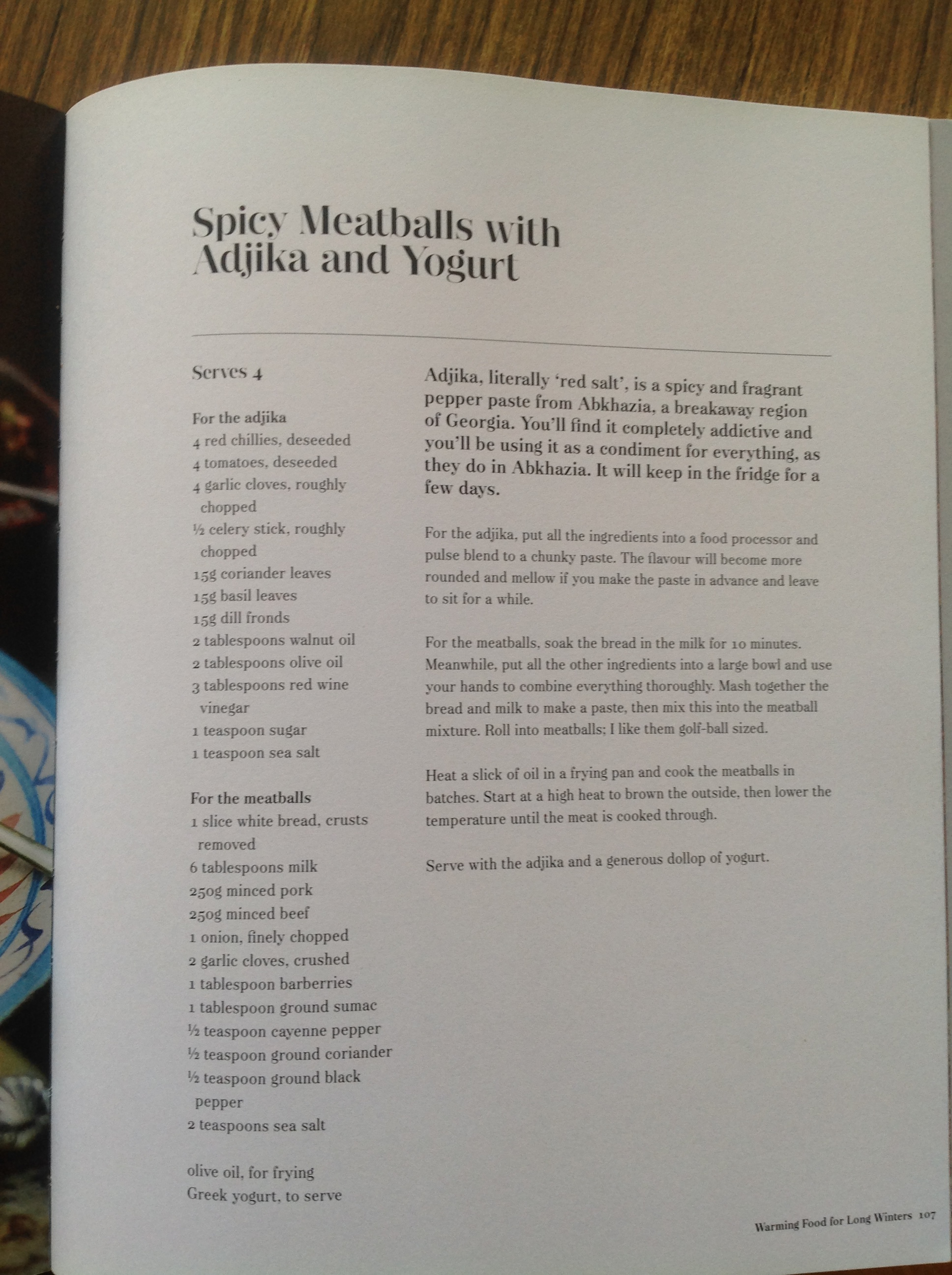
Spicy Meatballs with Adjika and Yogurt
Created 2019-04-18 · Updated 2019-04-18
From Samarkand by Caroline Eden & Eleanor Ford (Kyle Books, 2016)
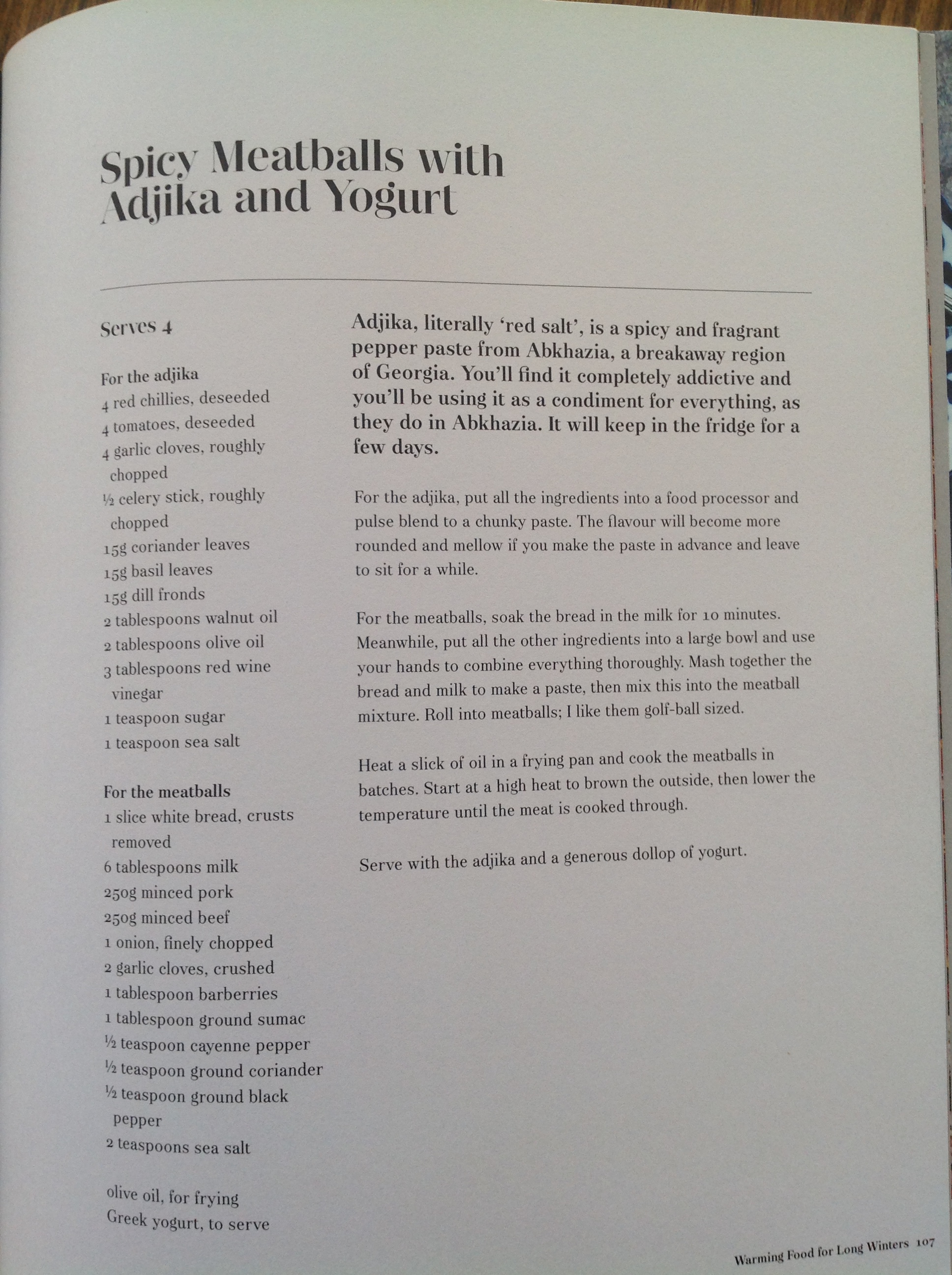
Adjika, literally ‘red salt’, is a spicy and fragrant pepper paste from Abkhazia, a breakaway region of Georgia. You’ll find it completely addictive and you’ll be using it as a condiment for everything, as they do in Abkhazia. It will keep in the fridge for a few days.
Serves 4
Ingredients
For the adjika
- 4 red chillies, deseeded
- 4 tomatoes, deseeded
- 4 garlic cloves, roughly chopped
- ½ celery stick, roughly chopped
- 15g coriander leaves
- 15g basil leaves
- 15g dill fronds
- 2 tablespoons walnut oil
- 2 tablespoons olive oil
- 3 tablespoons red wine vinegar
- 1 teaspoon sugar
- 1 teaspoon sea salt
For the meatballs
- 1 slice white bread, crusts removed
- 6 tablespoons milk
- 250g minced pork
- 250g minced beef
- 1 onion, finely chopped
- 2 garlic cloves, crushed
- 1 tablespoon barberries
- 1 tablespoon ground sumac
- ½ teaspoon cayenne pepper
- ½ teaspoon ground coriander
- ½ teaspoon ground black pepper
- 2 teaspoons sea salt
- olive oil, for frying
- Greek yogurt, to serve
Method
- For the adjika, put all the ingredients into a food processor and pulse blend to a chunky paste. The flavour will become more rounded and mellow if you make the paste in advance and leave to sit for a while.
- For the meatballs, soak the bread in the milk for 10 minutes. Meanwhile, put all the other ingredients into a large bowl and use your hands to combine everything thoroughly. Mash together the bread and milk to make a paste, then mix this into the meatball mixture. Roll into meatballs; I like them golf-ball sized.
- Heat a slick of oil in a frying pan and cook the meatballs in batches. Start at a high heat to brown the outside, then lower the temperature until the meat is cooked through.
- Serve with the adjika and a generous dollop of yogurt.
Photo
Spinach Khachapuri
Created 2019-04-18 · Updated 2019-04-18
From Samarkand by Caroline Eden & Eleanor Ford (Kyle Books, 2016)
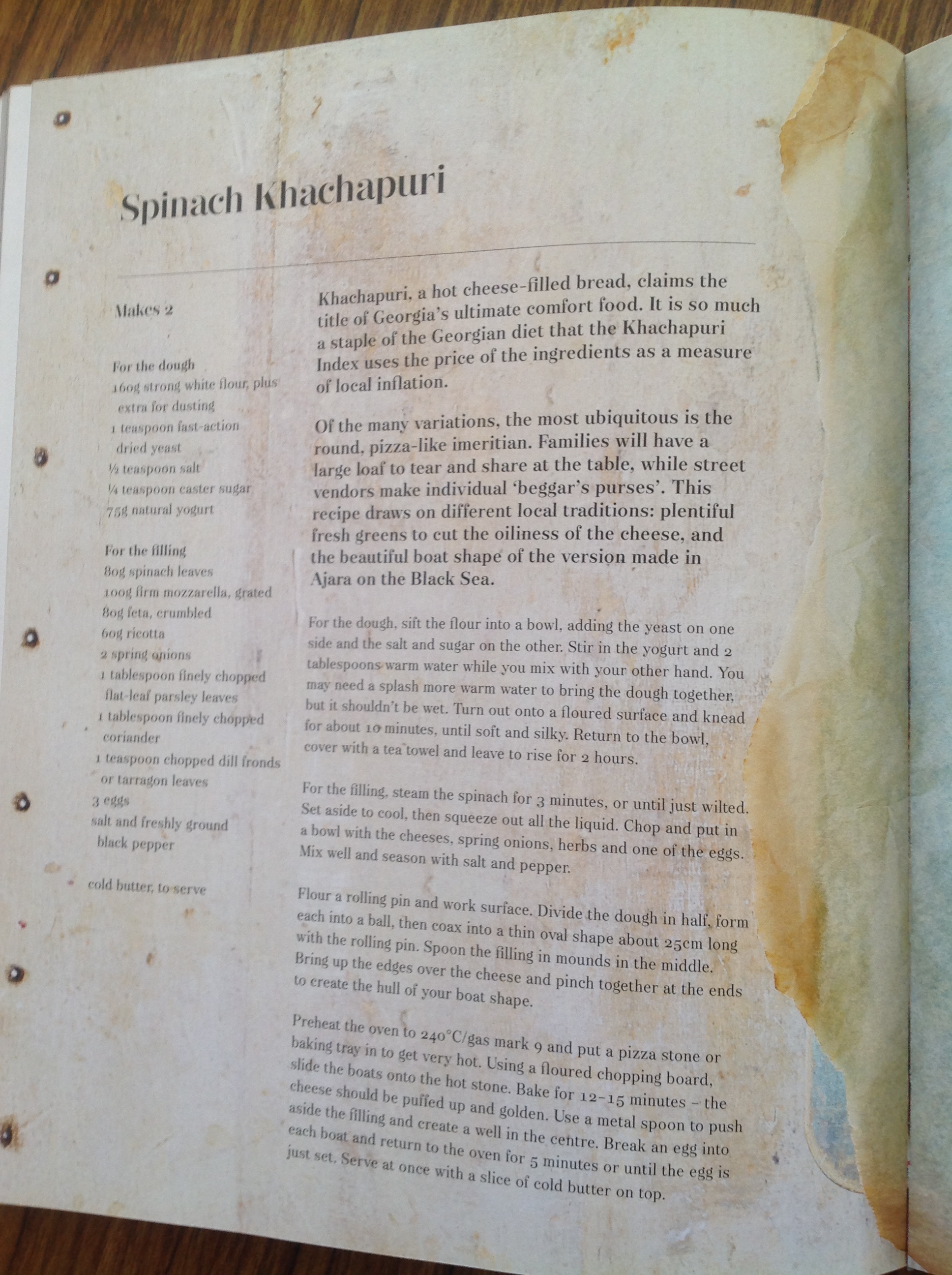
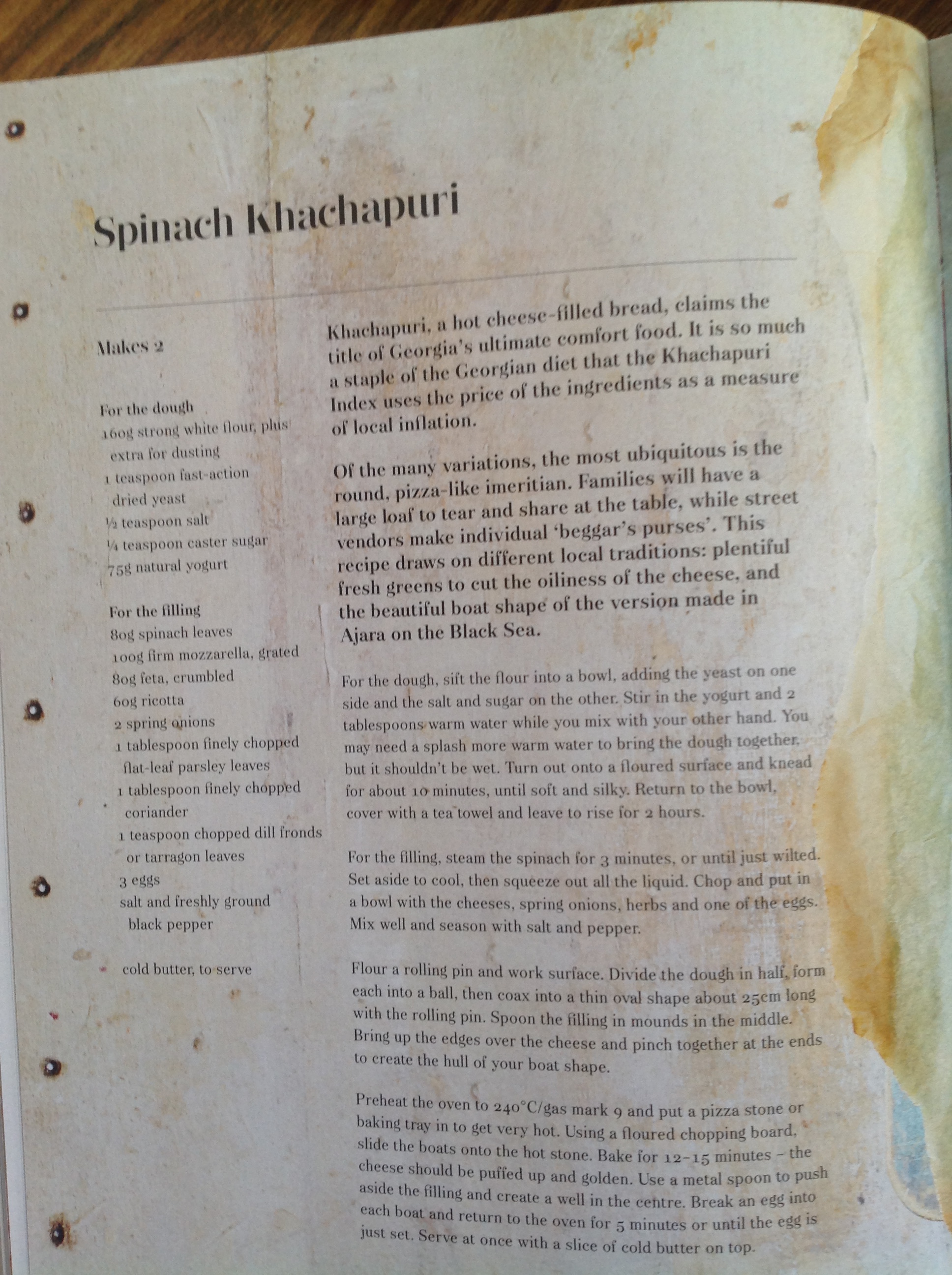
Khachapuri, a hot cheese-filled bread, claims the title of Georgia’s ultimate comfort food. It is so much a staple of the Georgian diet that the Khachapuri Index uses the price of the ingredients as a measure of local inflation.
Of the many variations, the most ubiquitous is the round, pizza-like imeritian. Families will have a large loaf to tear and share at the table, while street vendors make individual ‘beggar’s purses’. This recipe draws on different local traditions: plentiful fresh greens to cut the oiliness of the cheese, and the beautiful boat shape of the version made in Adjara on the Black Sea.
Makes 2
Ingredients
For the dough
- 160g strong white flour, plus extra for dusting
- 1 teaspoon fast-action dried yeast
- ½ teaspoon salt
- ¼ teaspoon caster sugar
- 75g natural yogurt
For the filling
- 80g spinach leaves
- 100g firm mozzarella, grated
- 80g feta, crumbled
- 60g ricotta
- 2 spring onions
- 1 tablespoon finely chopped flat-leaf parsley leaves
- 1 tablespoon finely chopped coriander
- 1 teaspoon chopped dill fronds or tarragon leaves
- 3 eggs
- salt and freshly ground black pepper
- cold butter, to serve
Method
- For the dough, sift the flour into a bowl, adding the yeast on one side and the salt and sugar on the other. Stir in the yogurt and 2 tablespoons warm water while you mix with your other hand. You may need a splash more warm water to bring the dough together, but it shouldn’t be wet. Turn out onto a floured surface and knead for about 10 minutes, until soft and silky. Return to the bowl, cover with a tea towel and leave to rise for 2 hours.
- For the filling, steam the spinach for 3 minutes, or until just wilted. Set aside to cool, then squeeze out all the liquid. Chop and put in a bowl with the cheeses, spring onions, herbs and one of the eggs. Mix well and season with salt and pepper.
- Flour a rolling pin and work surface. Divide the dough in half, form each into a ball, then coax into a thin oval shape about 25cm long with the rolling pin. Spoon the filling in mounds in the middle. Bring up the edges over the cheese and pinch together at the ends to create the hull of your boat shape.
- Preheat the oven to 240°C/gas mark 9 and put a pizza stone or baking tray in to get very hot. Using a floured chopping board, slide the boats onto the hot stone. Bake for 12–15 minutes – the cheese should be puffed up and golden. Use a metal spoon to push aside the filling and create a well in the centre. Break an egg into each boat and return to the oven for 5 minutes or until the egg is just set. Serve at once with a slice of cold butter on top.
Photo
Spinach Khachapuri (second photo)
Created 2019-04-18 · Updated 2019-04-18
More photos of Spinach Khachapuri; the full recipe text is there.
Photo
Winter Kuksu
Created 2019-04-18 · Updated 2019-04-18
From Samarkand by Caroline Eden & Eleanor Ford (Kyle Books, 2016)
Eaten hot in winter, cold in summer, this noodle soup is one of the most popular Koryo-saram dishes. It is also one where the fusion of Far Eastern and Central Asian flavours can most clearly be tasted. The sweet, umami-laden beef broth familiar to Korean palates is scented with dill and toasted sesame seeds as a nod to its regional home.
This recipe uses a quick pickled cucumber and kimchi, but you can vary these elements, depending on what you have to hand. Typical additions could include salted radishes, grated beetroot, stir-fried seasonal vegetables, grilled peppers or hard-boiled eggs. The soup is served with each ingredient arranged separately around the bowl.
Serves 4
Ingredients
For the pickled cucumber
- 2 small Korean cucumbers or ½ English cucumber
- 1 tablespoon sugar
- 1 teaspoon sea salt
For the beef
- 300g beef sirloin or fillet
- 2 teaspoons Korean chilli powder
- 1 teaspoon sesame oil
For the broth
- 1 litre hot beef stock
- 1 tablespoon dark soy sauce
- 1 tablespoon rice vinegar
- 2 tablespoons sugar
- ½ teaspoon sea salt
- a small bunch of dill fronds, chopped
To serve
- 160g egg noodles, fresh or dried
- 1 tablespoon sesame oil
- 100g kimchi
- 1 tablespoon sesame seeds, toasted
Method
- For the pickled cucumber, shave the cucumbers into ribbons using a mandolin, or slice into thin discs with a knife. Toss with the sugar and salt and leave to pickle for 10 minutes. Rinse off the seasoning and pat dry with kitchen paper. Taste to check if it needs a little more sweetness or salt.
- Preheat a ridged griddle pan. Rub the steak with the chilli powder, a little salt, then the sesame oil. When the pan is very hot, sear the steak for a minute or two on each side, until done to your liking. Set aside, covered, to rest while you make the broth.
- For the broth, heat the stock in a large pan and add all of the other broth ingredients. Taste to check the balance of flavours and adjust accordingly for sweetness, saltiness or tang.
- Cook the noodles according to the packet instructions. Drain and toss with the sesame oil. Mound a nest of noodles into the middle of four serving bowls and ladle over the hot broth. Slice the beef and pile onto one side of each bowl, drizzling over any meaty juices. Fill the remaining two-thirds of each bowl with a tangle of pickled cucumber and another of kimchi. Finally, sprinkle with the sesame seeds before serving.
Photo